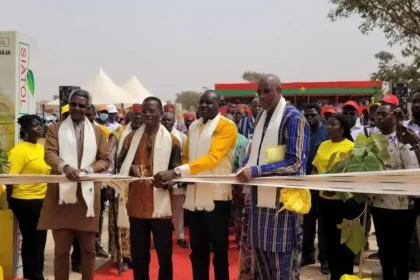
World soccer’s governing body, FIFA, has announced its intention to raise one billion USD (around 533.1 billion CFA francs) to build at least one Fifa-compliant stadium in each of the 54 African countries. President Gianni Infantino made the announcement during TP Mazembe’s 80th anniversary celebrations in Lubumbashi, DR Congo. To achieve this, Fifa will work with the Confederation of African Football (CAF) and other relevant stakeholders to improve refereeing, infrastructure and soccer competitions in Africa, according to BBC Africa.
“We want to take Africa to the highest level and show the world the exceptional talent and skills of your continent “, declared Gianni Infantino.
In addition, Ugandan President Yoweri Museveni has announced plans to build a new international stadium for the East African country to host matches at the African Cup of Nations (CAN) soccer tournament in 2027. The country will be co-hosting the CAN 2027 finals with Kenya and Tanzania. These structures represent an opportunity for manufacturers of tartan (a worn rubber-based floor), used in stadium surfacing.
An efficient technique
Tartan flooring is a type of water-permeable sports flooring used in tennis courts, basketball courts, athletics tracks, jogging and warm-up areas. It is mainly used around soccer pitches, indoor and outdoor sports halls and children’s playgrounds. It consists of two layers: SBR and EPDM granules. According to a report by the global tire industry CEO forum, one billion used tires are generated worldwide every year. Nearly four billion end up in landfill sites.
In Nigeria, a new era has dawned for rubber recycling through the ingenuity of start-up Freetown Waste, since 2022. While ten million used tires pile up every year in the country’s landfills, with significant health and environmental risks, start-up Freetown Waste Management Recycle has decided to recycle them into products for flooring, notably paving bricks and slabs for buildings. In just 4 years, the factory, based in Ibadan, Oyo State, has tiled several homes, technical offices, leisure parks, playgrounds and restaurants in Lagos, Nigeria’s economic capital. According to Theophlius Okoyomon, the start-up’s COO, the Nigerian market for rubber flooring is set to grow as demand for vehicles increases. As a result, the company is working with more than 150 people as tire collectors at tire dumps.
Recycling 15 million tires a year in Nigeria
The tire recycling plant has been awarded the Environmental Impact Assessment (EIA) certificate by the Oyo State Ministry of Environment and Water Resources, which will shortly enable it to access the manufacturing certificate awarded by the Federal Ministry of Trade and Investment. However, the young company, already present in Rwanda and Equatorial Guinea, is planning to expand its activities in other African countries such as Gambia, Ghana, Kenya, Senegal and South Africa.
Over 100,000 tires have been recycled into the company’s end products, but the aim is to recycle 15 million a year into useful reusable products for residential, commercial and industrial use, with a clear vision of being Nigeria’s leading recycled rubber manufacturer. We have a production capacity of 1,000 tonnes per year for both our crushing line and our manufacturing line, which produces around 400 m2 of tiles and 3,300 m2 of rubber mats per day, explains Ifedolapo Runsewe, Managing Director of Freetown Waste.
From waste to wealth
In Nigeria, a number of private companies are starting to collect used tires with the aim of transforming them into other products. Such is the case of Free Recycle, a company run by Ifedolapo Runsewe, which transforms old tires into paving bricks, flip-flop tiles and many other products. For her, sourcing used tires in Nigeria is a no-brainer. I think if you walk down the street for five minutes or ten minutes, I guarantee you’ll see at least ten tires in the drains, you’ll find them on the street corner in places where they ideally shouldn’t be. And I think that’s one of the things that got us into scrap tire recycling. Free Recycle started operations in 2018 with around four employees. Since then, the workforce has grown to more than 150. In six years, more than 600. 000 tires have been collected and more than 400,000 of them recycled into new products.
Most of the tires you see around you are a source of wealth, in fact from waste to wealth. A lot of people have been hired at this plant. You can see how many people work here, they make a good living, and that’s a great thing. And the products they make from here can be sold locally and abroad, said Bolanle Emmanuel, coordinator of the Nigerian Export Promotion Council in Oyo State.
Simplified recycling processes in Burkina Faso
In Burkina Faso, the Entrepreneurship & Adaptive Technologies (E&TA) program has launched a project to recycle used tires into floor tiles, in collaboration with the University of Ouaga II and the HES-SO (HEIA-FR & HEG-FR). The aim is to develop a simple, inexpensive process for manufacturing floor tiles from shredded tires, and to apply it in Burkina Faso to stimulate local entrepreneurship.
Before the tire can be ground, it has to be fragmented. The tire is then ground in a mill and a mixture of fiber, steel and rubber granules is recovered. This is followed by separation to obtain clean rubber granules. The usual technology for producing slabs from used tires involves the use of commercial polyurethane oligomer solutions, which are expensive and difficult to access in sub-Saharan Africa. As a result, an innovative process more suited to local conditions has been developed. The advantages are: the process is simple, accessible and more robust, and the slabs created can be recycled.
The process parameters were optimized using the Design of Experiments (DoE) methodology. The optimization criteria were: increased physical strength of the slabs, increased elasticity and reduced odor. The optimized process was transmitted to Burkina-Faso in the form of a simple “recipe”. Pilot production was set up in Ouagadougou, the country’s capital. Several collaborations have been set up, notably with the Ouagadougou town council and an association of used tire craftsmen, and a market study on the product has been carried out. The technology is likely to be exploited in other developing countries. A collaboration was recently established with the Integrated Polytechnic Regional College Karongi, in Rwanda, for the continuation of the project in that country.
Pneupur, winning markets in Cameroon
Cameroonian twin brothers Benjamin and Frédéric Belibi, automotive enthusiasts who studied in France, are fine-tuning a small revolution in the way used tires are generally treated in Cameroon. Thanks to Pneupur, a company based in the technopole of the National Advanced School of Engineering of Yaounde, they launched Cameroon’s first used tire recycling and recovery unit at the start of 2019. Built on a 3-hectare site in the locality of Bikok, in the country’s Centre region, this unit transforms the used tires collected nationwide into granules that can be used to cover the indoor courtyards of residential buildings and multi-sports fields, the floors of playgrounds, school playgrounds and other places where children play.
More than 120,000 sq.m. of space to cover in Yaounde
This industrial unit, which in 2018 aimed to create 41 direct jobs and 150 indirect jobs over a 3-year period, started with a processing capacity of 70,000 used tires, reaching 150,000 processed tires by the end of the 3rd year of operation. The plant would have required an investment of 544,595 USD (327 million FCFA). Patented by the African Intellectual Property Organization (OAPI), which covers 17 member countries, the process is adapted to the tropical climate of this part of the world. For the time being, the start-up uses a local subcontractor to produce the granules from old tires. “We add a solvent-free resin to make it an eco-responsible product,” explains Frédéric Bélibi. The company, which employs six people in addition to the co-founders, then manufactures and installs the flooring itself, writes the online media outlet Entrepreneurs les Echos. There’s a real demand locally, because most playgrounds are made of clay or cement, an unsuitable surface, continues the entrepreneur, who estimates the market potential in the Cameroonian capital at over 120,000 m².
E-Cover’s prowess in Senegal
Founded in 2020, E-Cover is a Senegalese company specializing in waste recycling and reclamation. Co-founded by Yaye Souadou Fall and Khady Diallo, the startup is active in tire recycling, which it transforms into rubber granulates, tiles, shoe soles and flooring for businesses, households, sports complexes, schools and town halls.
The idea of recycling tires began very early on with very rudimentary equipment, namely meat grinders. The first investment enabled the purchase of 20 mincers to increase production capacity. Supported by the WIC (Women Investment Club), E-cover now has a production plant with state-of-the-art industrial recycling equipment located in Dakar’s industrial zone on a 1600 m2 site. The company has around thirty collection points in Dakar. Equipped with an in-house laboratory, E-Cover strives to produce calibrated, quality aggregate that meets international standards, and is in the process of obtaining FIFA certification in order to gain greater market share in the synthetic turf sector, according to the Act Afrique news site.