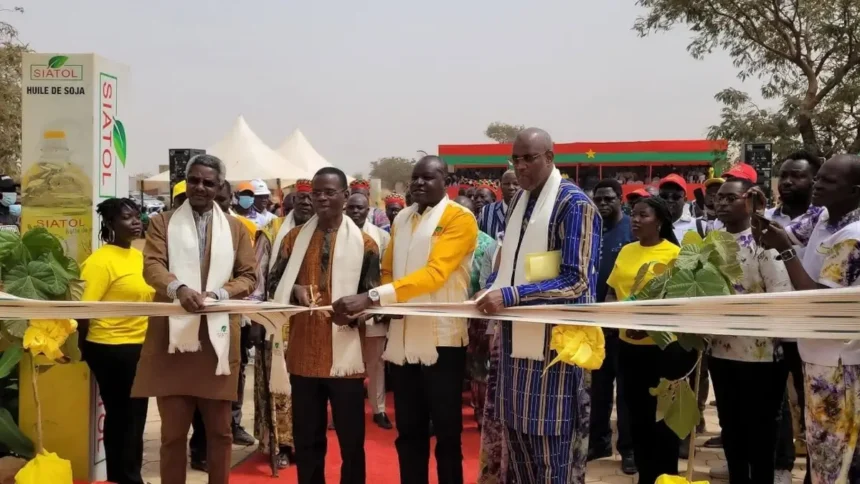


The total cost of the infrastructure is estimated at nearly 2 billion CFA francs. Through this investment, the project aims to enhance national food sovereignty by prioritizing the local processing of oilseeds. The initiative benefited from government support, including the allocation of a 3,520-square-meter plot of land in the industrial zone and approval under the investment code. Public mechanisms also contributed to facilitating the project’s financing. On the private sector side, Ecobank Burkina Faso, Coris International, and the investment fund Néré Capital played key roles in supporting the project.
Founded in 2010 and operational since 2011 with second-hand equipment, SIATOL initially started on a modest scale. Despite these limited beginnings, the company managed to process more than 5,000 tons of soybeans between 2013 and 2017, gradually establishing its presence in the domestic market. Fifteen years later, the company has significantly expanded its operations. The new industrial complex now boasts substantial production capacity: soybean crushing capacity of 40 tons per day, equivalent to about 12,000 tons annually; an oil refining capacity of 10 tons per day, representing approximately 3,000 tons of refined oil each year; and animal feed production for poultry and livestock reaching up to 100 tons per day, or nearly 30,000 tons annually. Overall, the installed capacity could reach a total production potential of up to 130,000 tons. At present, the plant is operating at around 70% of its capacity, reflecting a strong start to its operations.
Promoting soybeans to strengthen food self-sufficiency
According to the company’s CEO and promoter, Marcel Ouédraogo, the decision to focus on soybeans is based on a clear strategic vision: locally processing a raw material with high nutritional value in order to generate greater value across the entire supply chain. On average, soybeans contain around 20% oil, which is rich in essential fatty acids such as omega-3 and omega-6, as well as vitamin E. During the refining process, the oil is also fortified with vitamin A. Marketed under the SIATOL brand, this soybean oil, labeled “100% made in Burkina Faso,” is now available in supermarkets and retail outlets across the country. The soybean meal produced during the crushing process is also an important input for the manufacturing of animal feed. It is used in the production of complete feed for laying hens, broiler chickens, and livestock.
By incorporating other ingredients such as maize, wheat bran, and vitamin supplements, SIATOL is strengthening its position in two strategic sectors: human consumption and animal nutrition. Beyond its industrial achievements, the project also has significant socio-economic impacts. The company currently employs 145 permanent workers, in addition to numerous seasonal employees. It has established partnerships with more than 3,000 smallholder farmers, particularly in the province of Sissili, ensuring a stable supply of soybeans while providing reliable market opportunities for producers. Its distribution network includes more than 60 retail points, directly generating over one hundred additional jobs. Moreover, thousands of livestock farmers across the country use the company’s poultry and livestock feed products on a daily basis.
Targeting 50 billion CFA Francs in revenue. As part of its growth strategy, SIATOL aims to generate cumulative revenue of 50 billion CFA francs over the next five years. In the short term, the company plans to build a seconde production unit dedicated to poultry and livestock feed by the end of 2026, with a daily production capacity of 200 tons. It also intends to install a new soybean crushing line capable of processing an additional 40 tons per day. If these investments materialize, SIATOL could establish itself as a leading player in oilseed processing not only at the national level but also across the wider West African sub-region.