

Ivory Coast is Africa’s leading exporter of natural rubber. Rubber production is concentrated in the southern part of the country (south, south-east, south-west). It is increasingly expanding in the central and eastern zones, to the detriment of coffee and cocoa. The most productive localities are Bonoua, Anguédédou, Sikensi, Dabou, San-Pedro, Grand Bereby, Soubré, Gagnoa and Bettié.
From an economic standpoint, natural rubber has become the country’s second-largest agricultural export after cocoa. In 2018, sales in this sector reached USD 820 million (CFAF 495 billion), including USD 165 million (CFAF 100 billion) allocated to producers. During the same period, revenues distributed to farmers increased from 66 million US dollars (40 billion F CFA) to 165 million US dollars (100 billion F CFA), announced Koffi Konan Albert, deputy executive secretary of the Association des professionnels du caoutchouc naturel de Côte d’Ivoire (Apromac). The industry supports 900,000 people and generates 300,000 direct jobs.
500,000 tonnes processed locally per year
With the aim of processing all Ivorian natural rubber production by the end of 2024, the government inaugurated Africa’s largest rubber processing plant on October 26, 2023. The Loeth plant, built by Ivory Coast based company involved in rubber farming activities. (SAPH) in Soubré, in the west of the country, has a capacity of 60,000 tonnes of rubber per year.
According to the Ivorian authorities, this new factory, valued at 33 million US dollars (20 billion CFA francs), will generate over 600 direct and indirect jobs, including 320 existing jobs, with over 20% going to women. It will also provide business opportunities for local companies in Soubré. The processing sector remains a major challenge for Ivory Coast . Currently, only 30 to 40% of national production is processed locally, with an installed industrial capacity of around 500,000 tonnes per year.
The remainder is exported as latex or raw rubber, according to data collected by Afrika Foward experts. They are mainly exported to Asia, notably China and Malaysia, where they are processed. The country has several processing plants, mainly located in the Grand-Bassam, San Pedro and Abidjan regions. These plants produce various products derived from natural rubber, including tires, shoe soles, industrial gloves and parts for the automotive industry.
Adding value to rubber wood
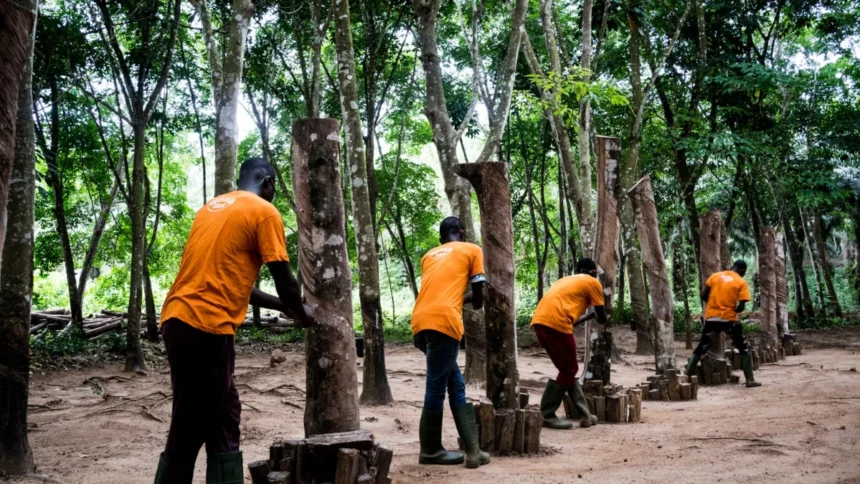
Ivory Coast intends to find an outlet in high-value finished products for wood from rubber trees felled on rubber plantations when they no longer produce sufficient latex. Processing exotic rubberwood into lumber and fuelwood should enable Ivory-Coast to produce around 700,000 m3 (cubic meters) of edged sawn timber/year at a price of USD 102 to USD 507 (FCFA 65,000 to 300,000) per cubic meter.
Hevea cultivation in Ivoiry coast is the main source of income from rubber marketing. And today, since we know very well that prices rise and fall, we need to find additional income for the grower. And indeed, today we’re talking about rubberwood, and in the future rubberwood should provide additional income for the grower,
says Emmanuel Yacé, president of the Association des professionnels du caoutchouc, Ivory Coast, quoted by Africa 24. Process 100% of its natural rubber production by 2025
Ivory Coast’s objective is to process 100% of its natural rubber production by 2025, compared with around 80% in 2021. To achieve this, the country needs new 1st transformation units to reach the target of 100% transformation by 2025, and 2nd transformation units, which is a virtually untapped segment to date. It is the ambition of the Fédération des organisations professionnelles agricoles de producteurs de la filière hévéa de Côte d’Ivoire (FPH-CI) to increase the area planted with rubber trees by 100,000 hectares by 2027.
Natural rubber is an exceptionally strong, flexible and extremely waterproof material. It is used in the manufacture of tires, shoe soles and rubber gloves (disposable and reusable). It is also used in the manufacture of condoms, balloons and industrial products (belts, gaskets, hoses, industrial mats, etc.), medical equipment (catheters, breathing tubes and other medical devices, as well as latex mattresses and pillows). These products illustrate the importance of natural rubber in many industrial and domestic sectors.
Tax breaks for investors
The authorities have introduced tax incentives for investors. These include exemptions on imported equipment and tax credits. Several processing units have been announced in the production zones. Ordinance No. 2019-826 of October 09, 2019 grants specific tax incentives, i.e. additional benefits to those provided for under the investment code, to rubber processors (the duration of the ordinance is 3 years).
In a participatory approach, the entire value chain, led by the Apromac and the Conseil hévéa palmier à huile (Chph), has been promoting the rubber industry in Ivory Coast for several years. Hevea processing is eligible under the investment code, which grants operators tax and customs exemptions.