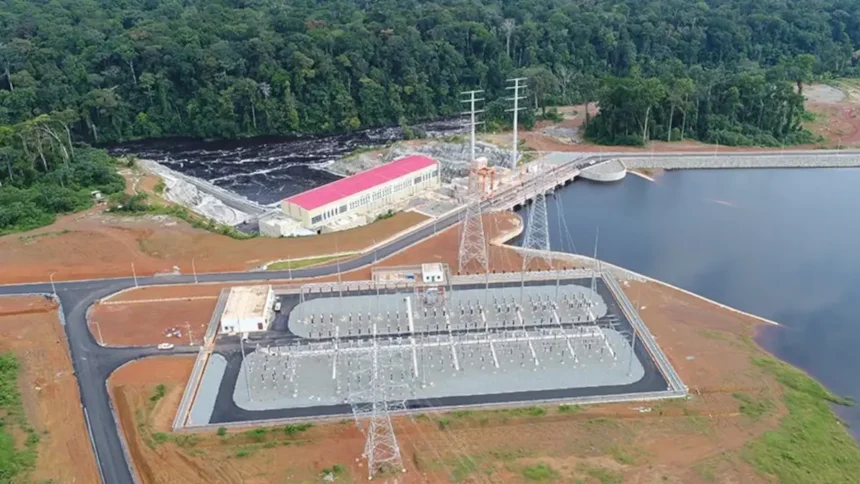


As part of its operation and maintenance action plan, the public utility has launched an international tender to recruit a specialized company responsible for the industrial maintenance of the plant’s equipment. The objective is to ensure full availability of the facilities and optimize electricity production performance. The selected contractor will be responsible for predictive, preventive and corrective maintenance, with a focus on ensuring maximum mechanical availability of the facilities in line with hydrological conditions and grid demand. The assignment also includes round-the-clock safety and security of personnel and installations, as well as close technical collaboration with EDC’s operating teams to ensure operational continuity.
Memve’ele: a hydropower plant operating far below its potential
With an installed capacity of 211 MW, the Memve’ele power plant currently produces only about 100 MW, based on a river flow of 250 m³/s, according to official estimates. This output remains well below its design capacity due to a persistent hydrological deficit on the Ntem River. Unlike the Songloulou and Edéa hydropower plants, which benefit from upstream reservoir dams within the Sanaga River basin, Memve’ele operates without a regulating reservoir. This structural limitation makes the plant highly vulnerable to seasonal fluctuations in river flow. From the outset, several sector experts questioned the government’s decision to build a 211 MW hydropower facility on the Ntem River, whose average flow is significantly lower than that of the Sanaga.
During oral questions at the National Assembly on March 25, the Minister of Water and Energy, Gaston Eloundou Essomba, announced the acceleration of a reservoir dam project on the Ntem River, following instructions from the Head of State.
Looking ahead, and in order to mitigate the impacts of hydrological variations on the Ntem River, the Head of State has instructed the acceleration of the maturation of the reservoir dam construction project on this river,
the minister stated. The project aims to stabilize Memve’ele’s electricity production during the dry season and prevent the sharp output drops that have repeatedly affected the Southern Interconnected Grid.
Power shortages amid maintenance works and grid saturation
Cameroon has experienced renewed power rationing, affecting both major cities and rural areas. According to Eneo, the national electricity utility, constraints are affecting the entire value chain generation, transmission and distribution. Generation constraints Memve’ele: output dropped to 35 MW, a loss of 55 MW due to hydrological stress, Kribi gas power plant : production reduced to 160 MW out of 216 MW installed, due to maintenance works
Total estimated capacity loss: at least 110 MW. Transmission bottlenecks : chronic saturation of the transmission network, the Edea-Douala corridor limited to 540 MW for a demand of 671 MW, despite available generation of 811 MW and failed installation of newly acquired transformers by Sonatrel due to manufacturing defects. Distribution challenges are overloaded medium- and low-voltage transformers, aging infrastructure and rising electricity demand driven by illegal connections
Cameroon’s Southern Interconnected Grid has normaly a generation capacity of 1,536 MW, compared to an estimated demand of 1,206 MW. Under optimal conditions, supply should exceed demand without heavy reliance on costly thermal generation. However, a structural gap persists between installed capacity and effective production, driven by : a hydrological deficit estimated at 3 billion cubic meters of water, unplanned outages and maintenance backlogs, and severe transmission constraints. Hydropower plants are operating in sub-optimal conditions : Nachtigal : 260 MW produced for a flow of 650 m³/s, versus 420 MW expected, Songloulou: 320 MW for 900 m³/s, below the 384 MW expected and Memve’ele: 100 MW for 250 m³/s, far below its 211 MW design capacity.
Outlook and reform agenda
To address these systemic weaknesses, the government has launched structural reforms through the National Energy Compact, developed under the Mission 300 initiative. The stated objectives include strengthening generation capacity, upgrading transmission infrastructure, securing electricity supply and supporting economic growth. In the short term, however, the stability of Cameroon’s power system will largely depend on: the return of favorable hydrological conditions, improved reliability of existing infrastructure, and better coordination of maintenance planning, investment execution and sector governance.