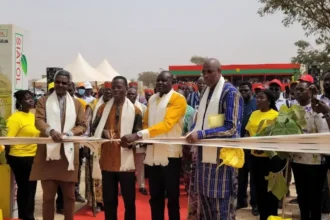
Rwanda, often seen as a hub for digital and technological innovation in Africa, has taken a bold step by welcoming the EH216-S air taxi, designed by the Chinese group EHang. This autonomous two-seater was presented in Kigali, marking the continent’s first trial of this type of aircraft. The project stems from a strategic partnership between Rwanda and China, aimed at boosting the adoption of advanced technologies in Africa. The arrival of the EH216-S is not a coincidence. Rwanda has long pursued a strategy of technological openness to strengthen its position as a regional hub. For the Rwandan government, this is more than just a symbolic step: it is a matter of economic positioning.
Rwanda is a small country. We must be bold and seize new technologies to accelerate our development,
emphasized Jimmy Gasore, Rwanda’s Minister of Infrastructure. According to him, aerial mobility could become a driver of urban transport, tourism, and even medical logistics in the years to come.
The partnership with EHang falls within this framework of openness. The company, listed on the Nasdaq and a global leader in autonomous aerial mobility, sees Africa as a promising market.
We are convinced that Rwanda can become the entry point for aerial transport on the continent,
declared Huang Qilin, Vice President of EHang, during the demonstration in Kigali. The EH216-S: an innovation at the service of mobility
The EH216-S, unveiled in Kigali, is a multicopter designed to carry two passengers or up to 220 kilograms of payload. Powered by 16 electric motors and equipped with a carbon fiber structure, it reaches a cruising speed of 100 km/h and can cover a distance of 35 kilometers in just over 20 minutes. Its design combines comfort and safety. The butterfly-style doors and wide panoramic windows offer an exceptional view of the city. The aircraft also includes a double-parachute system, automatic take-off and landing procedures, and a control system that operates without a pilot on board. Recharging the batteries requires about two hours, making the system compatible with intensive daily use.
A potential revolution for urban transport
For Kigali, the ambitions are clear: to position itself as a laboratory for new forms of mobility. In a city where traffic congestion is already a growing challenge, aerial transport could provide a sustainable alternative to relieve the roads.
The Rwandan government also envisions applications beyond urban transport. Air taxis could support tourism by offering panoramic flights over the country’s green hills and national parks. They could also play a key role in medical logistics, complementing the existing drone network used to deliver blood and medicines to remote hospitals. Globally, several countries are experimenting with air taxis, from the United Arab Emirates to Europe and China. The first commercial routes are expected to launch by 2030, with projected investments in the sector exceeding $1 trillion by mid-century.
By positioning itself early, Rwanda hopes to attract investors, startups, and research centers. This positioning is consistent with Kigali’s past successes: the country was one of the first in Africa to use drones for medical deliveries through the American company Zipline, a project that has become a reference on the continent. By extending this logic to passenger air mobility, Kigali confirms its ambition to remain at the forefront of technological adoption in Africa.
A strategic choice for investors
The adoption of the EH216-S in Rwanda offers a double opportunity: to explore new business models in mobility and to test advanced technologies in a favorable regulatory environment. With the support of the Chinese partner and government openness, Kigali is emerging as a testing ground for aerial transport in Africa. For investors, the message is clear: Rwanda wants to accelerate its integration into the global innovation value chain. By becoming the first African capital to welcome an air taxi, Kigali is signaling that the future of mobility on the continent may well be written in its skies.