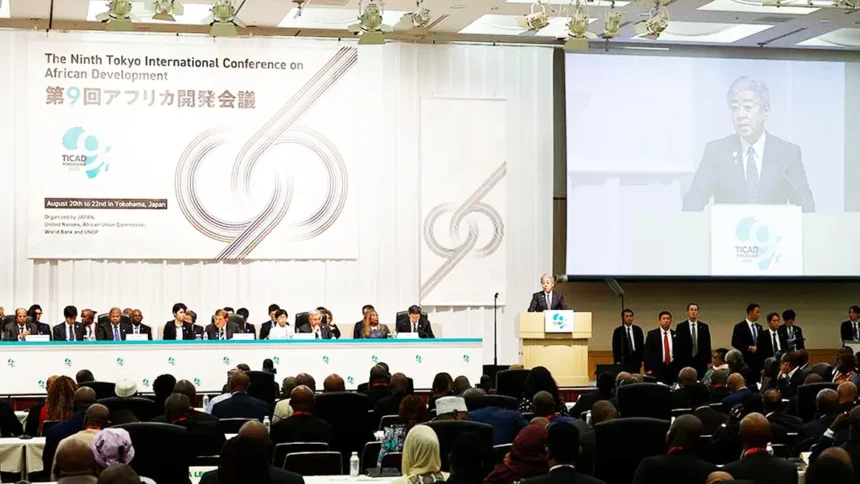


The AfDB comes to Yokohama with a leadership team aligned with sectoral priorities: Kevin Kariuki for power, energy, climate and green growth; Solomon Quaynor for private sector, infrastructure and industrialization; Nnenna Nwabufo for regional development, integration and service delivery; and Kevin Urama as chief economist and vice president for economic governance and knowledge management. Alongside them, several directors carry portfolios ready for discussion with Japanese public and private counterparts. The goal is explicit : to position the AfDB as a magnet that directs international flows especially from Japan toward bankable African projects.
EPSA : from proof of concept to scale up
The Enhanced Private Sector Assistance (EPSA) initiative, launched in 2005 with the Government of Japan, forms the backbone of this cooperation. It rests on four interconnected pillars: the Accelerated Co-financing Facility for Africa, non-sovereign loans, the Fund for African Private Sector Assistance, and direct financing of private investments. The cumulative results speak for themselves: more than USD 12 billion mobilized since 2005 in favor of African infrastructure and enterprises, with emblematic achievements such as Uganda’s Bujagali hydropower plant, the first pan-African telecom satellite RASCOM, the Eastern Africa submarine cable system, and Kigali’s water treatment plant.
More Read
Launched at TICAD 8 in 2022, EPSA 5 targeted USD 5 billion over 2023-2025. To date, USD 4 billion have already been co-financed, with another USD 1.6 billion expected by the end of 2025, bringing the total to USD 5.6 billion 112% of the original target. At Yokohama, JICA and the AfDB shift gears with EPSA 6, raising the bar to USD 5.5 billion for 2026-2028, with an explicit emphasis on resilience, as highlighted by JICA President Akihiko Tanaka during the ceremony attended by Japanese Finance Minister Katsunobu Kato and Kevin Kariuki.
Energy : The top priority and test of credibility
Without reliable, affordable electricity, neither industrialization nor large-scale essential services are possible. On the eve of the official opening, JICA and partners hosted an event framing the urgency: 600 million Africans remain without reliable access to electricity 83% of the world’s unconnected population and 900 million lack access to clean cooking solutions. Five countries Nigeria, the Democratic Republic of Congo, Ethiopia, Uganda, and Tanzania account for nearly half this population. Moderated by Wale Shonibare, AfDB Director of Energy Financial Solutions, Policy and Regulation, the session stressed the need to consolidate regional power pools and sustain investment in grids, generation, and interconnections.
We see enormous potential in Africa’s regional power pools,
he said, calling for TICAD to be a catalyst for innovation and co-financing.
Drone technology: from road maintenance to risk management
Beyond traditional projects, TICAD 9 broadened the spectrum with a Letter of Intent signed on 21 August 2025 between the AfDB and Japanese drone leader Aerosense Inc. Signed by Solomon Quaynor and Kohtaro Sabe on the conference sidelines, the agreement formalizes cooperation to deploy drone solutions for sustainable infrastructure. Selected following a June 2025 call for proposals under the Africa Sustainable Road Maintenance Program, Aerosense’s technology will undergo demand and feasibility studies adapted to local geographical realities. The Bank will facilitate public-sector engagement, lead awareness campaigns, support African partners’ capacity building, and explore debt and equity financing instruments. For Quaynor,
this program is a bold response to Africa’s growing infrastructure challenges,
with use cases ranging from road management to flood control, agricultural monitoring, and medical supply delivery.
It is a great honor to serve African communities with our Japanese technology,
added Kohtaro Sabe, rooting the cooperation in a commitment to improving quality of life.
The Africa Investment Forum as an investment marketplace
The Africa Investment Forum (AIF), co-led by the AfDB with eight partner institutions, is positioned at TICAD as the marketplace to turn interest into transactions. The December 2024 Market Days in Morocco tested the Japan-Africa corridor’s potential, with a dedicated “Agricultural Innovation and Green Growth” stream bringing together over 100 Japanese companies, start-ups, and public institutions. By showcasing bankable projects in green hydrogen, transport, sustainable agriculture, health, and climate resilience, the AIF provides the missing negotiation platform between African promoters and Japanese investors.
Partners and instruments to de-risk investments
Over time, AfDB-Japan cooperation has deepened and diversified with JICA, JBIC, and NEXI. The combination of concessional lines, export credit insurance, and accelerated co-financing lowers the cost of capital, supports non-sovereign operations, and attracts institutional investors. Minister Katsunobu Kato emphasized in Yokohama that by focusing on resilience, EPSA 6 will help African countries facing high debt levels while stimulating private investment better protected against shocks.
TICAD 9 sets a more ambitious trajectory. Success will depend on execution: macroeconomic stability, predictable PPP frameworks, sector reforms, stronger regulators, rigorous project preparation, and tailored financial engineering. With Japan’s partnership, the AfDB now has a full toolkit to turn pledges into productive assets. The 2026-2028 window will be the true test of delivery capacity.