

Ranked as the 20th largest economy worldwide by the Organisation for Economic Co-operation and Development (OECD) in 2024, with a nominal GDP of $941 billion, Turkey has become a leading partner for many African nations. Senegal is among the countries that have effectively leveraged this momentum. Over recent years, Turkish investments have contributed significantly to the development of key infrastructures across the country. Several landmark projects illustrate the strength and dynamism of this bilateral partnership. Notably, the Abdou Diouf International Conference Center (CICAD), built by the Turkish firm Summa, is a state-of-the-art facility funded at 51 billion CFA francs, with 31.8 billion provided by Turk Exim-Bank.
Another flagship project is the Blaise Diagne International Airport (AIBD). The Turkish consortium Summa-Limak handled the completion, testing, calibration, and commissioning phases of this strategic airport, representing an estimated total investment of 74 billion CFA francs. In the realm of sports and event infrastructure, the Dakar Arena with a capacity of 15,000 spectators and the Dakar Expo Center further demonstrate Turkish commitment. Both projects, managed by Summa, required an investment of approximately 74 billion CFA francs. The hospitality sector has also benefited from Turkish investment, exemplified by the Radisson Hotel in Diamniadio, comprising 152 rooms and costing around 33 million euros. Additionally, the construction of the National Market and the main bus station in Diamniadio, led by Turkish company De Meew (DM), marks another important milestone, with a total investment of 68 billion CFA francs, nearly 49 billion of which was financed by Turkey and the remainder by the Senegalese government.
Towards new strategic cooperation
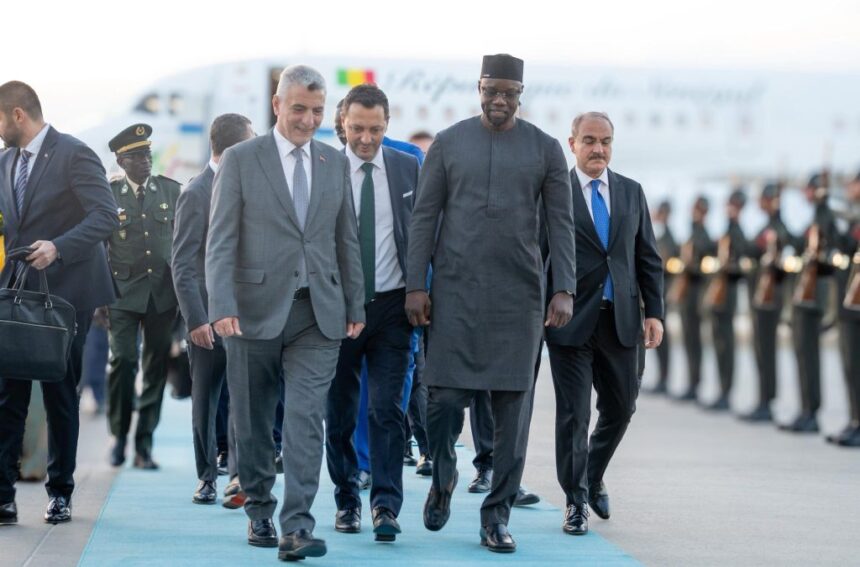
These key projects not only highlight the depth of economic ties between Dakar and Ankara but also their tangible contribution to Senegal’s infrastructure development and economic transformation. Beyond existing initiatives, Prime Minister Sonko’s visit aims to establish new partnerships in strategic sectors such as industry, agri-food, textiles, automotive, and electronics. These areas are priorities in Senegal’s economic recovery plan. Turkey, which has gradually positioned itself as a major industrial player, offers a valuable model for Senegal’s progressive industrialization. Its network of dynamic SMEs, integration into global value chains, and aggressive export policies present promising avenues for technical and commercial cooperation.
More Read

The bilateral cooperation also holds considerable potential in several key sectors. Economically, Senegal could benefit from Turkish expertise in construction, industry, and energy through infrastructure development, renewable energy projects, and large-scale public works. With its manufacturing and trade experience, Turkey could help Senegal boost exports of agricultural products, dried fruits, and textiles to the Turkish market and beyond. In tourism, cooperation could translate into joint promotion of destinations, increased Turkish investments in hotel and service infrastructure, and enhanced valorization of Senegal’s cultural and natural heritage.
Furthermore, professional training and skills transfer are key levers through exchange programs in higher education, technology, and technical apprenticeships. Agriculture is another promising area for collaboration. Development of agricultural technologies, efficient irrigation systems, and sustainable natural resource management could improve productivity and combat drought. Finally, health partnerships could strengthen the fight against tropical diseases and improve access to basic healthcare.