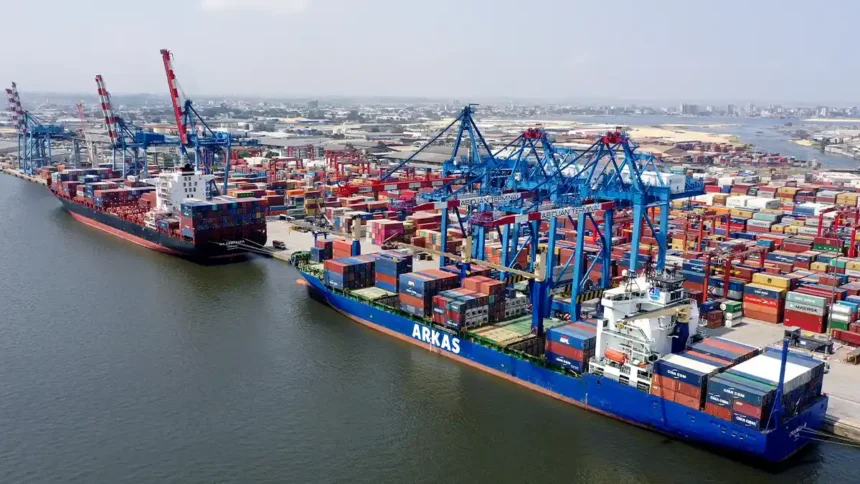


To understand what the Port of Abidjan means to Ivory Coast, a few figures are enough. The PAA concentrates approximately 90% of the country’s customs revenue and contributes up to 60% of the Ivorian state’s total income. Nearly 70% of national GDP passes through its infrastructure. This is not just another port it is a backbone. In 2025, national traffic grew by 19.8% to reach 34.2 million tonnes, driven in particular by exports of cocoa of which Côte d’Ivoire remains the world’s largest producer but also by petroleum products and minerals. Hydrocarbons alone accounted for 25% of total traffic, while general cargo grew by 20% and container volumes increased by 12%. The financial transformation is equally striking. Over the span of ten years, the port’s turnover has tripled, rising from 51 to 153 billion CFA francs. A trajectory that reflects both the modernization efforts undertaken and the broader growth dynamic of the Ivorian economy as a whole.
This performance was not built overnight. For several years, the PAA has been implementing a massive investment program estimated at 1,100 billion CFA francs, with the objective of fundamentally transforming its capacity and competitiveness. Among the most structurally significant projects is the widening of the Vridi Canal, the port’s maritime access channel, which now accommodates larger vessels. The construction of the TC2 container terminal has significantly increased processing capacity. The digitalization of operations automated counters, paperless customs procedures, digital flow tracking has reduced processing times and strengthened the port’s competitiveness against its regional rivals, most notably Dakar and Lomé.
These reforms are part of a public-private partnership model that has attracted international operators and accelerated the upgrading of infrastructure. The results are visible : the PAA now targets 2 million TEUs twenty-foot equivalent units, the standard measure for container volumes by 2027, which would allow it to enter the global top 100 container ports.
A gateway for the whole of West Africa
The reach of the Port of Abidjan extends well beyond Ivorian borders. The PAA handles 70% of the external trade of five landlocked countries : Burkina Faso, Mali, Niger, Chad, and Guinea. For these nations with no direct access to the sea, Abidjan is often the unavoidable passage point for their imports and exports. In 2025, this role as a regional hub strengthened further: transit traffic surged by 34.1% to reach 3.91 million tonnes, a progression that illustrates the growing confidence of sub-regional operators in the port’s logistics capabilities. These supply corridors by road and rail serve as vital arteries for economic integration within WAEMU and ECOWAS. This regional dimension is not merely a source of national pride. It gives the PAA a genuine geopolitical role: that of an economic stabilizer for an entire West African hinterland, in a context where several landlocked countries are navigating severe political and security turbulence.
A major employer and industrial driver
The port’s impact cannot be measured in tonnes or customs revenue alone. Directly and indirectly, the PAA employs between 50,000 and 75,500 people, a considerable employment pool for the Greater Abidjan area. But its role in the productive economy goes even further: 65% of Ivorian industrial units depend on its flows for their supply of raw materials or the export of their finished goods.
Sectors as varied as agri-food, chemicals, construction, and textiles are directly dependent on the smooth functioning of the port. In this sense, the PAA is not merely a transit point it is an engine of industrialization, whose performance directly conditions the competitiveness of the entire Ivorian productive fabric. The picture would be incomplete without acknowledging the challenges the port still faces. Congestion on land access routes remains one of the most persistent pain points : the lines of trucks at the port’s approaches are a visible sign of a bottleneck that growing traffic tends to worsen. Cybersecurity represents another increasingly significant concern, as the digitalization of operations exposes the system to new categories of risk.
For 2026, the PAA has planned several concrete responses: continued dredging of the Vridi Canal, the creation of new logistics zones on the outskirts, and an acceleration of the green transition aligned with the United Nations’ 2030 Agenda. More than 60 million euros have been mobilized to modernize equipment and improve the flow of road and rail access.
A barometer that does not lie
Approaching its 75th anniversary, the Autonomous Port of Abidjan can take stock of the distance it has traveled. From an infrastructure inherited from the colonial era, it has transformed itself into a major economic actor whose performance is watched well beyond Ivorian borders. But what makes the PAA truly singular is its capacity to function as a synthetic indicator of the country’s economic health. When the port is doing well traffic up, record revenues, investments underway it means the Ivorian economy is moving forward. When it slows down, it is often the signal of a deeper turbulence. In 2025, the message was unambiguous: Côte d’Ivoire is moving forward, and it is moving fast.
The ambition for the years ahead matches this trajectory: to make Abidjan not only the leading port in West Africa, but a model of an intelligent, resilient, and sustainable port one capable of accompanying the development of an entire region in a world undergoing profound transformation.