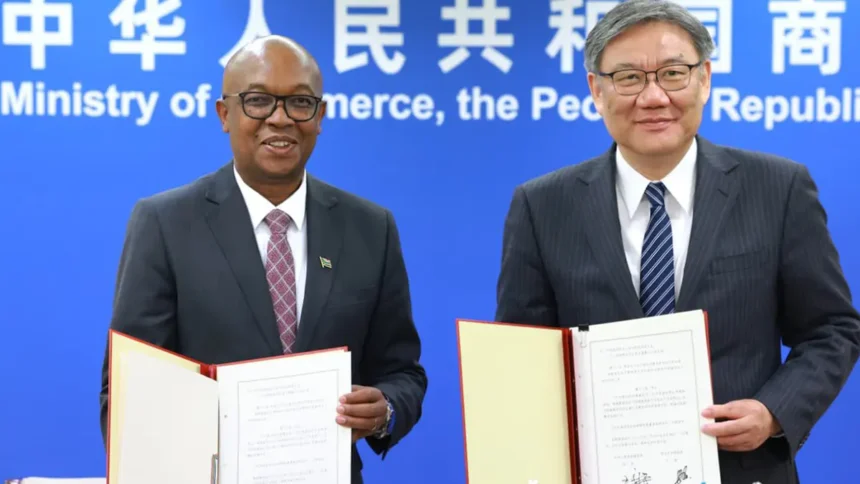


China will not require reciprocity under the recently signed economic and trade partnership agreement with South Africa, according to Chinese Ambassador to Pretoria, Wu Peng. “In this process, China will fully take into account South Africa’s interests and will not seek reciprocity,” the diplomat said in remarks reported last week by the Chinese English-language newspaper South China Morning Post. In practical terms, South African goods will be granted duty-free access to the Chinese market, without being obligated to lower its own tariffs on imports from China. On February 6, South Africa and China signed a framework economic partnership agreement known as CAEPA (Framework Agreement on Economic Partnership for Shared Prosperity). The agreement aims to boost trade exchanges and increase investment flows between the two BRICS member states.
However, CAEPA does not yet constitute a full-fledged free trade agreement. Rather, it establishes a negotiation framework designed to evolve over time. Pretoria and Beijing have committed to concluding an “Early Harvest Agreement” a partial trade deal by the end of March 2026. This initial phase is expected to include tariff preferences and possibly duty-free access for selected South African exports. The agreement had nonetheless raised concerns in South Africa about a potential reciprocity clause that could destabilize key domestic industries, particularly the automotive sector. Beijing’s decision to waive reciprocity comes as China prepares to eliminate tariffs on all imports from African countries with which it maintains diplomatic relations, effective May 1, 2026.
An agreement also benefiting chinese companies operating in South Africa
The generalized tariff exemption was announced by President Xi Jinping during the 39th African Union (AU) Summit, held on February 14-15 in Addis Ababa. The measure will apply to all African trade partners of China, with the exception of Eswatini (formerly Swaziland), the last African country maintaining diplomatic ties with Taiwan.
The stated objective is to rebalance trade relations. China, Africa’s largest trading partner, runs a significant trade surplus with the continent a situation that has drawn increasing criticism in recent years. In January, the South African government had even threatened to raise tariffs on Chinese and Indian vehicle imports to curb the sharp rise in shipments from the two countries. Chinese business lawyer and Africa specialist Kai Xue said the agreement between Beijing and Pretoria “should also benefit Chinese companies operating in South Africa.”
According to him, the non-reciprocal, duty-free access to the vast Chinese market extended to all African countries except Eswatini is intended to strengthen the viability of special economic zones and industrial parks where numerous Chinese firms are active. For its part, Pretoria is seeking to diversify its trade partnerships to safeguard the competitiveness of its exports, following the imposition by the Trump administration of tariffs of up to 30% on certain South African products. South Africa remains China’s largest trading partner in Africa. It exports products such as wine, fruits, cereals, rooibos, and a broad range of minerals to the Asian economic powerhouse. In 2025, bilateral trade between the two countries reached $53.58 billion.